
Frequently Asked Questions
The most frequently asked questions on Asset Performance Management (APM)
- What Is Asset Performance Management?
Gartner defines Asset Performance Management (APM) as a market of software tools and applications designed to improve the reliability and availability of physical assets (such as plants, systems of equipment, and infrastructure) essential to the operation of an enterprise. It is an umbrella term for all the technologies focused on improving the performance of a physical asset. - What Is Condition Based Maintenance?
Condition based maintenance (CBM) is equipment maintenance executed when certain indications imply performance degradation. CBM uses the data of an asset to determine its usage and actual status. On a basis of the asset data performance decrease, upcoming asset failure can be determined and certain trends can be identified. - What Is Predictive Maintenance?
Predictive maintenance (PdM) is the scheduling of maintenance based on indications from different systems. PdM takes the maintenance one step further compared to condition based maintenance by looking at the patterns across all sensors and predicting asset failure rather than reacting when certain indications imply performance degradation. - What Is Prescriptive Maintenance?
Prescriptive Maintenance (RxM) is a type of maintenance that leverages all of the mentioned technologies (machine learning, Internet of Things (IoT) and big data analytics) in order to produce outcome-focused recommendations for operations and maintenance. It not only predicts asset failure but is also able to offer actionable solutions while measuring the impact of the recommended solutions on the affected operations. - What Is a Digital Twin?
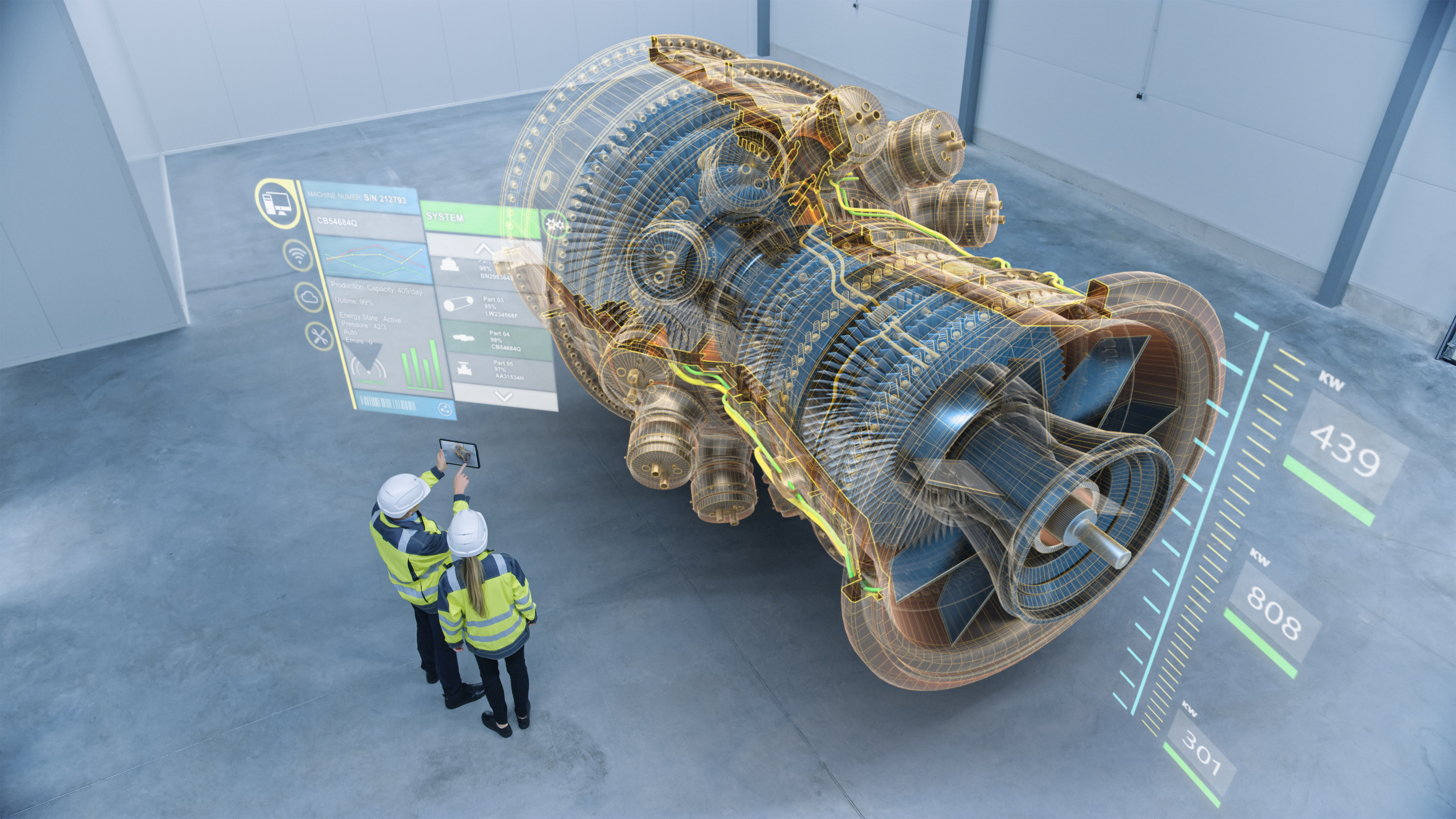
Digital twin is a virtual replica of a physical asset or a system. It incorporates all the technology used in Prescriptive Maintenance and is the last step in optimising asset performance management. Essentially, it is technology that takes real-world data about a physical asset as input and produces predictions or realistic simulations on that asset as output. Digital twins can be manipulated in order to optimise the performance of that physical asset. - How Do I Get Started?
Usually, we follow a simple process consisting of 4 steps:
Data Scan – we conduct a 2-3-day asset data scan on your critical assets to evaluate the organisation’s data quality, availability and completeness;
Business Case – we then work together and assess if there is an opportunity for a business case within the organisation;
(optional) Organisation Readiness – we assess whether the company has a clear strategic commitment towards entering Industry 4.0 and the right resources and processes to take immediate action;
Proof of Concept – we then work together in order to create a proof of concept for a tailored solution within the company.
If you have more questions regarding the process, feel free to send us a message or book a call. - Do I Own the Data?
Generally, the owner of the asset is also the owner of the data. In case you want to create additional services based on the asset data, more detailed agreements will be made for the data ownership. - Is My Data Safe?
In most cases, we provide our software on premise running on a server of the customer or a private cloud. Our customers take care of the data security and we support the requirements. In case of a cloud offering, we are also using different security protocols including advanced encryption and hiding, amongst others. - How Long Does the Implementation Take?
The length of implementation is dependent on the urgency of the transformation and the available resources. Apart from that, the quality, availability and completeness of the current asset data is also important. Fast implementation can be finished within weeks but larger and more complex projects could take more time. - Where Can I Deploy the Software?
Our APM software can be deployed on a large variety of hierarchical levels:On a chip in a device;
On edge computers managing different devices;
On a server, both on-premise or in the cloud. - How Do I Use the APM Studio Software?
Our platform is user-friendly, easy-to-use and is designed for engineers and others to use with a low/no coding approach. Just by dragging and dropping, you are able to set up the logic and processing to create your Asset Performance Management application. The ease of use does not decrease the high customisability of the software though. You will, of course, receive the initial training, user manual of the software and the support of our experts. - Is it possible to define and perform comprehensive reliability, maintenance, and mechanical integrity analytical functions, including asset strategy identification and execution, within a single platform?
APM Studio integrates condition-based monitoring (CBM), predictive maintenance (PdM), and Bowtie cause-consequence models (bringing your FMEA/FMECA’s live on streaming data) for defining and managing asset strategies. The platform uses Digital Twins for real-time asset monitoring and analysis, while automated workflows and Decision Support Rules ensure the effective execution of maintenance actions automatically to your EAM or CMMS. Object models, classes, and multi-level deployment options help visualize, scale, and manage large quantities of data and assets efficiently. Additionally, Complex Event Processing (CEP) allows real-time event correlation and proactive response, making APM Studio a robust tool for digitization of asset services on a single platform. - What types of integrations are available with SAP models, including but not limited to SAP MDM, SAP PM, and SAP HR? Can you explain in detail how your technology supports these integrations?
Asset and process notifications, at different severity and priority levels, generated by APM Studio, can be queried by a wide range of EAMs and CMMSes that support REST-API interfaces. All events necessary to be broadcasted in APM Studio can be configured to be available for EAM/CMMS integration. Certain EAM/CMMS vendors that support IoT interfaces can subscribe to the continuous MQTT event streams of an APM-Studio solution. - How does the system generate work orders, notifications, and triggers based on events or conditions?
APM Studio has the capability to generate work orders, notifications, and triggers based on specific events or conditions by leveraging its capability of Processing Rules (enabling CBM, PdM and ML Algorithms), Complex Event Processing (CEP), and Decision Support Rules. The platform uses CEP to continuously analyze streams of events and alarms, identifying critical conditions in real-time. When a condition is met, the CEP engine can trigger actions such as generating notifications or initiating workflows. Additionally, Decision Support Rules interact with users to determine the appropriate responses, which can include generating work orders or other corrective actions. APM Studio also integrates seamlessly with Enterprise Asset Management systems (EAM) Computerized Maintenance Management Systems (CMMS) by providing REST Services, allowing your systems to query and automatically create work orders from the detected events and conditions, ensuring a smooth maintenance workflow and timely response to asset needs. - How can data be exposed for querying through Business Intelligence (BI) tools?
APM Studio has REST API capability meaning that all the insights provided by processing rules, alarms, notifications, decision support rules et cetera can be made available for querying for other external applications and parties as required. Since APM Studio comes with an integrated time-series database, these insights and their history are easily available. Also, it is important to mention that APM Studio can run “headless” meaning running only as a server without UI providing the processed insights to the BI tools. - How does the solution provide visibility into asset health and generate alarms and alerts?
APM Studio provides comprehensive visibility into asset health by continuously monitoring data and evaluating key performance indicators (KPIs) that can be fully customized. The platform can generate alarms and alerts based on predefined conditions or unexpected changes in asset behavior, ensuring that maintenance teams are promptly notified of potential issues. - How does the system facilitate Failure Modes, Effects, and Criticality Analysis (FMECA) and Reliability Centered Maintenance (RCM) based on industry standards?
APM Studio facilitates Failure Modes, Effects, and Criticality Analysis (FMECA) and Reliability Centered Maintenance (RCM) by using BowTie cause-consequence models to bring these analyses to life on streaming data. The BowTie method enables real-time monitoring of potential failure causes and their consequences by linking risk models to live asset data. This approach helps in identifying failure mechanisms early, continuously assessing risk, and supporting proactive maintenance decisions. By integrating these models with live data streams, APM Studio ensures that FMECA and RCM processes are dynamic and aligned with industry standards, improving reliability and reducing asset risks. - How does the system identify and report assets causing significant issues (bad actors)?
By continuously monitoring asset performance and analyzing key metrics, the platform can detect recurring problems or underperforming assets. Through dashboards and alerts, APM Studio highlights these bad actors, allowing maintenance teams to prioritize actions and focus on resolving the underlying issues. Users can filter alarm browsers and dashboards to showcase the worst-performing assets first, and also low-performance KPIs will instantly bring attention to bad actors. - How does the platform support both quantitative and qualitative risk assessment approaches?
APM Studio supports both quantitative and qualitative risk assessment approaches. Quantitative assessments include processing rules that enable condition monitoring and predictive maintenance, as well as running Machine Learning models, KPIs, and generating alarms/notifications based on live streaming data from assets. Cause-consequence models are used in both quantitative and qualitative assessments; for example, FMEA/FMECAs, which are qualitative by nature, can be brought live on streaming data, making them quantitative. Decision Support Rules support qualitative assessments by guiding users through prescriptive steps to resolve issues. - How can hazard analysis and what-if scenarios be performed for asset risk management?
APM Studio supports hazard analysis and what-if scenarios for asset risk management by leveraging its powerful cause-consequence models. These models allow users to simulate various risk conditions and evaluate their potential impacts in a controlled environment (connected to data from the field). In What-If mode, the central Alarm is created when at least one cause of the Bowtie is confirmed by its Controls. This mode is typically used for monitoring conditions in your application (i.e. you want to prevent something from happening and act or notify your users early). APM Studio’s Testing capability further enhances this by enabling users to tweak parameters and observe how the system responds, effectively running customized what-if scenarios.